Language
Country/Region
Plexiwire
Low stock: 10 left
Couldn't load pickup availability
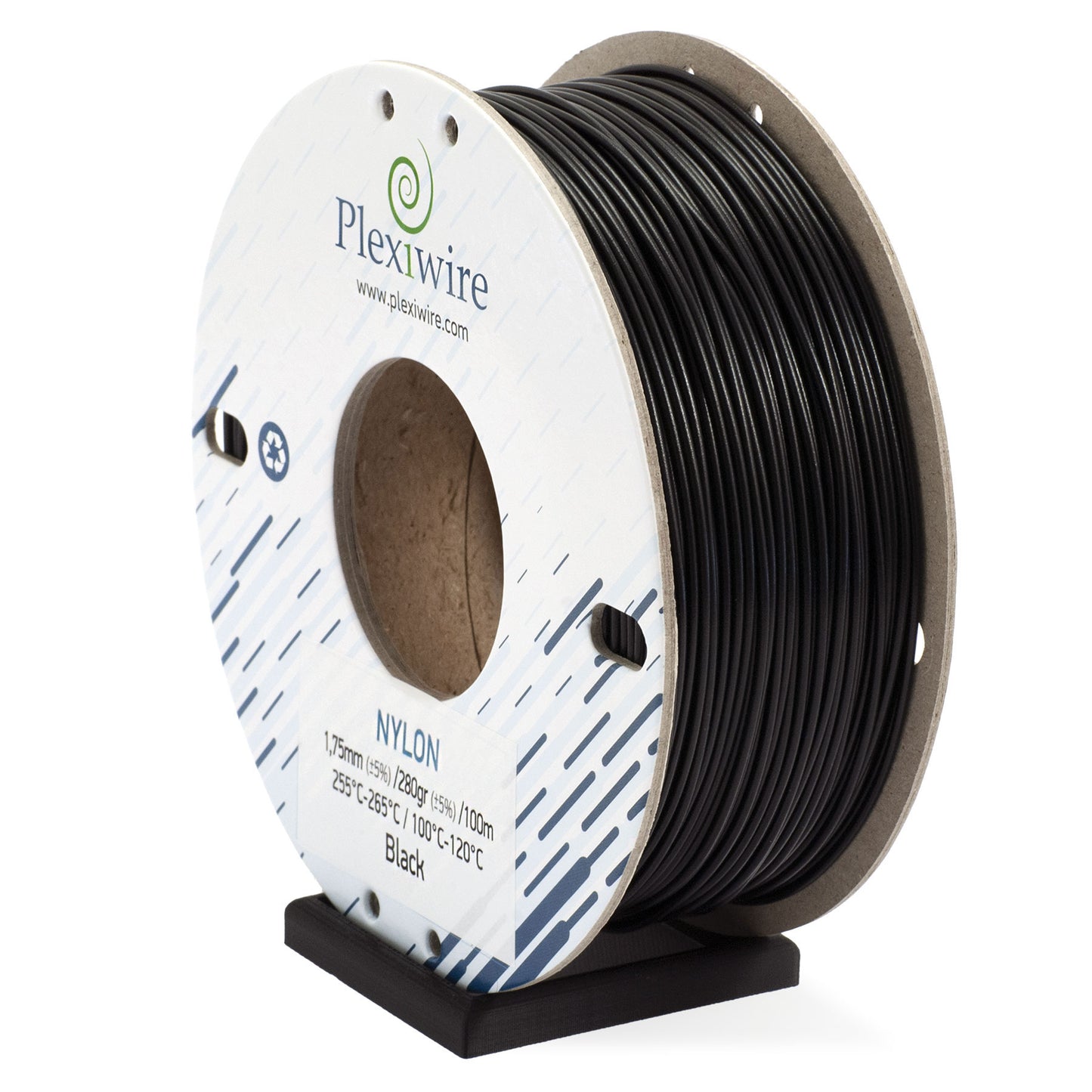

Black none filament 1.75 in a 275 g (100 m) spool is designed for precise, manageable 3D printing.
Its compact size makes it easy to switch materials and handle short runs.
With black none filament 1.75, extrusion stays stable and layers build consistently once your setup is in place.
The filament feeds smoothly and reduces the need for constant adjustments.
A 275 g spool is ideal for testing designs and printing specific parts.
Even in this format, none filament 1.75 maintains reliable output.
None filament black offers a clean, neutral appearance.
It also helps hide minor surface imperfections.
Black none filament is suited for prototypes and small functional parts.
Black none filament 1.75 in a 275 g (100 m) spool integrates easily into everyday workflows.
Technical specifications
Technical data of the spool
Application
With the help of NYLON plastic, moving parts of machines and mechanisms are often printed, both for prototypes and for serial use. It is also used to create components of mechanisms in which there is a high load, strong friction or the influence of aggressive environments - for example, these can be clutches and gears and other movable and immovable connections. In addition to directly working parts, it can be used to create cases if they contain power elements.
Printing Guidelines
NYLON can be called the most hygroscopic material of all that are widely used in 3D printing. It absorbs moisture from the air faster and more actively than other materials. Therefore, it must be stored in airtight bags, be sure to dry immediately before printing, and periodically dry during storage so that too much moisture does not accumulate. When printing NYLON, you need to ensure reliable fixation of the first layer and choose an average print speed so that the models do not deform. It is better to print them with small products of not complex design. It is also worth using closed chambers of a 3D printer and eliminating airflow to reduce shrinkage of the product.
Do not use NYLON for basic modeling and everyday tasks. It is a difficult-to-print engineering plastic that is best used only for special applications, in which it will show its properties as efficiently as possible.

