Language
Country/Region
Most shops selling 3D printer filament source it through a chain of distributors. When a batch behaves differently, the cause is difficult to trace and difficult to correct.
Plexiwire manufactures its own. Every spool comes off our extrusion line, backed by 20 years of industrial polymer extrusion. The practical benefit is consistency: reorder a colour mid-project and the second spool matches the first, with no re-tuning and no visible seam where the batch changed.
All Plexiwire filaments are 1.75 mm, compatible with any standard FDM 3D printer without hardware changes, and suitable for both hobby and professional 3D printing. Select the material by the demands placed on the part.
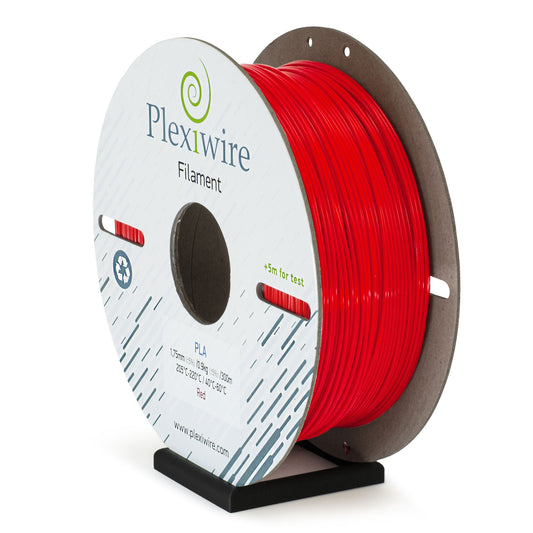
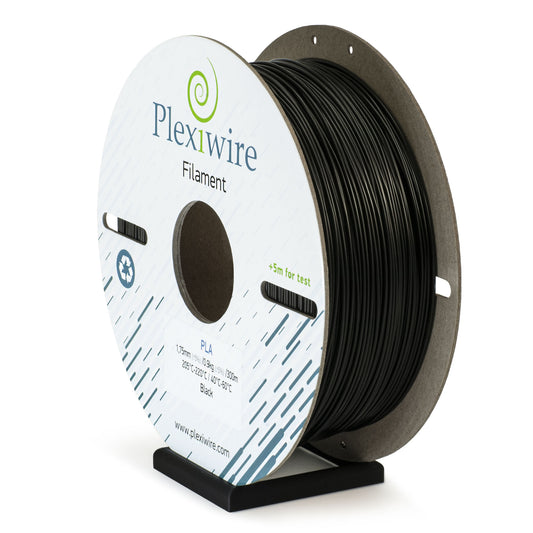
PLA prints at 200–230 °C with a 40–60 °C bed. It suits models, prototypes and general display parts, and is available in 19 colours.
PETG prints at 230–255 °C with a 50–70 °C bed. It is the choice for parts used outdoors, under load, or in elevated temperatures.
ABS and ABS+ print at 235–250 °C with a 90–110 °C bed and require an enclosure. Both offer heat resistance to approximately 95 °C and accept drilling and tapping.
ASA prints hotter, at 260–270 °C with a 90–100 °C bed, and retains colour and strength under UV where ABS degrades.
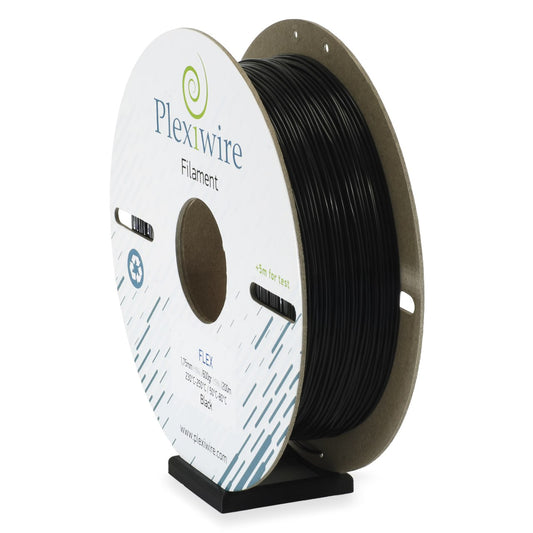
FLEX 90A (230–250 °C) suits gaskets, grips and bumpers. Nylon PA6 (250–265 °C) suits gears and hinges. PCTG (230–255 °C) offers higher impact resistance than PETG. CF10 is available in four base materials for stiffness and dimensional stability.
For most users the progression is straightforward: begin with PLA, move to PETG when a part must withstand heat or load, and choose ABS, ASA or Nylon only when an enclosure is available and the application requires it. The majority of printing is well served by PLA and PETG.
Every spool is Ø200 mm with a Ø55 mm hub and 69 mm width, standard dimensions compatible with AMS-style feeders and dry boxes. Spools are cardboard rather than plastic. Sizes range from 300 g / 100 m to 1.2 kg / 400 m for production runs.
If you are selecting between materials, a 300 g spool of PLA and one of PETG is an economical way to test both before committing to a larger size.