Language
Country/Region
Chopped carbon fibre has two effects. It increases stiffness, reducing flex under load and creep over time, and it improves dimensional stability, so CF parts warp less than their unfilled equivalents and present a matte finish that conceals layer lines.
It does not increase strength in every respect. Fibres add rigidity at a small cost to impact toughness. For parts that must withstand impact, unfilled PETG is the better choice.
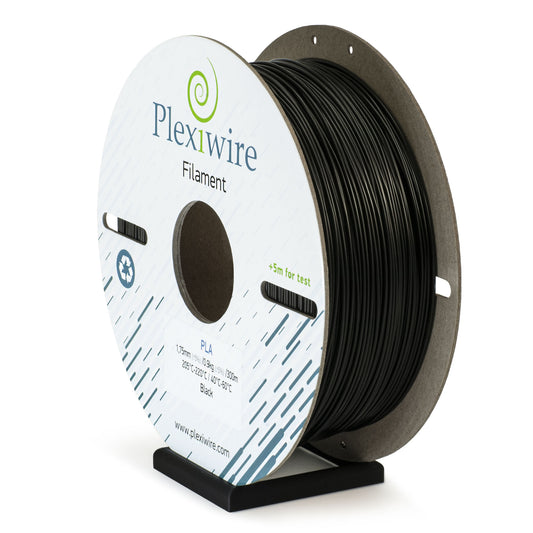
PLA CF10 (205–220 °C, 40–60 °C bed): the easiest CF material to print, with the least warping, a matte black finish and noticeably higher stiffness than standard PLA.
PETG CF10 (230–255 °C, 50–70 °C bed): stiffness combined with PETG's heat and impact tolerance. The most versatile of the four.
ABS CF10 (235–250 °C, 90–110 °C bed): heat resistance with substantially reduced warping. Enclosure required.
Nylon CF10 (255–265 °C, 100–120 °C bed): wear resistance combined with stiffness. Requires drying before printing.
Carbon fibre is abrasive and will wear a brass nozzle out of tolerance within one or two spools, causing dimensional drift. Fit a hardened steel or ruby nozzle before printing any CF material. This is a requirement, not a recommendation.
CF10 is black across all four materials, as carbon fibre content precludes pigment. Spool sizes follow each base material.